|
The Scientific MethodThe scientific method is arguably one of the most powerful, if not the most powerful methodology in critical thinking for discovering how things work.
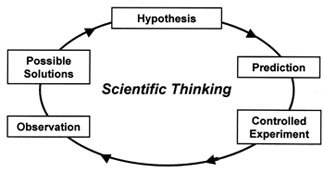
For centuries, scientists, engineers, mathematicians, and others have used this method to advance the human knowledge base. The scientific method uses hypothesis, prediction, controlled experiment, observation, and potential conclusions (possible solutions). With this method scientist are able to discover many things.
Curie also helped provide the groundwork for nuclear medicine and the discovery of the structure of the atom. Another example of using scientific method comes from work done in the jungle. Jane Goodall is an English behaviorist who worked with and learned about chimpanzees (Homo sapiens’ closest relatives) at the Gombe Stream Reserve in Tanzania Africa. Her discoveries were revolutionary. She was able to show that chimpanzees hunt, approximate language and engage in warfare. Goodall also discovered that chimpanzees make and use tools. Previously, tool making was thought to be a human defining characteristic.#1
The Scientific Method Scientists learn from the experiences of those before them. If a new hypothesis (theory) is found to be more accurate than a previous theory, then that new theory becomes the accepted norm. The scientist who came up with the previous theory isn’t thought of less. He or she is thought of as having helped other scientists to learn better explanations to the way our world and the people in it operate. To the true scientist the ultimate goal is to eliminate ego, politics and pride in order to discover the ultimate truths of the universe. For example, Sir Isaac Newton’s explanation of the effects of gravity was accepted as truth until Albert Einstein improved upon Newton’s theory and also explained why gravity works the way it does. Einstein’s theory of gravity is still the accepted theory for large objects. Einstein used Newton’s ground work as his starting point. Einstein continued his work in physics making major discoveries in relativity, gravity, space, time, matter and energy. For the final decades of his life, Einstein worked on a unified field theory to explain and relate the physical world of the very large and of the very small (quantum mechanics). "Imagination is more important than knowledge. Knowledge is limited. Imagination encircles the world." ~ Albert Einstein
Return from The Scientific Method to Problem Solving Techniques |